
The Company Brain: What It Buys You and What It Takes
by
Kadhir Mani
(5 minutes)
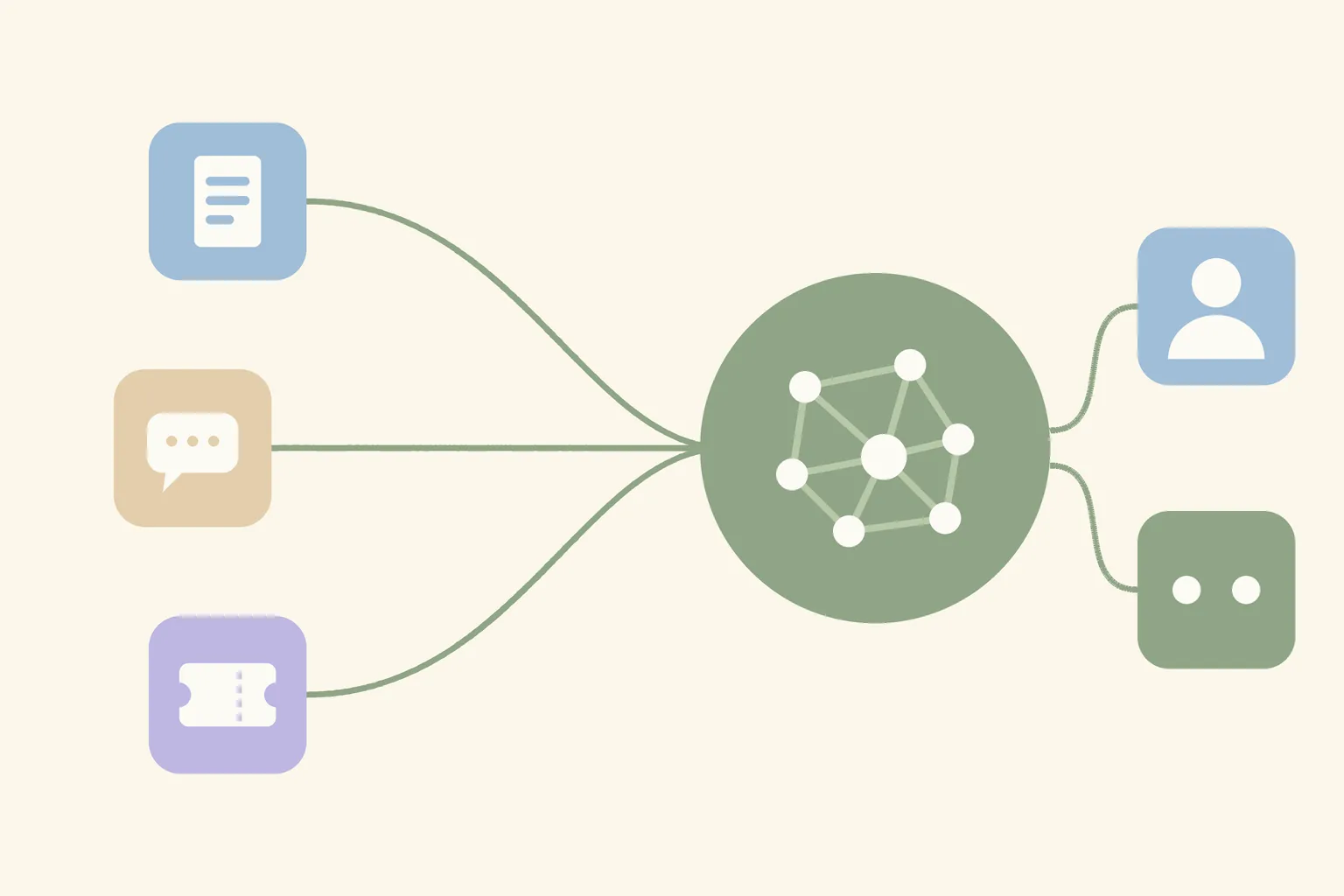
<section data-section-id='79d650ca-76d3-43eb-b9dc-40a387e83ed5'><p><span style="white-space: pre-wrap;">Every company runs on knowledge it can't find. The answer to your question exists somewhere, in a doc, a Slack thread, a ticket, a decision that five people remember slightly differently. The gap between what the organization knows and what any one person can actually reach is where productivity goes to die.</span></p><p><br></p><p><span style="white-space: pre-wrap;">A </span><b><strong style="white-space: pre-wrap;">company brain</strong></b><span style="white-space: pre-wrap;"> is an AI-powered knowledge layer that aggregates everything the org knows and makes it queryable in plain language by people and AI agents alike. A company brain should synthesize a grounded answer, drawn from your actual institutional knowledge, with the sources to back it up.</span></p><p><br></p></section>
<section data-section-id='4aaab266-aa4f-4821-98a6-28dc1a64702e'><h2 id="key-benefits"><span style="white-space: pre-wrap;">Key benefits</span></h2><p><span style="white-space: pre-wrap;">A company brain pays for itself across four dimensions</span></p><ul><li value="1"><b><strong style="white-space: pre-wrap;">Consistent AI agents.</strong></b><span style="white-space: pre-wrap;"> Agents aren't wandering around MCP-style, poking at tool after tool and coming back with different answers depending on the path they took. They query the brain directly, so they return consistent answers rapidly, every time.</span></li><li value="2"><b><strong style="white-space: pre-wrap;">Time savings.</strong></b><span style="white-space: pre-wrap;"> Knowledge workers burn roughly a fifth of their week searching for information that already exists somewhere in the org. A structured, queryable memory layer collapses that search time to seconds.</span></li><li value="3"><b><strong style="white-space: pre-wrap;">Faster onboarding.</strong></b><span style="white-space: pre-wrap;"> New hires stop depending on tribal knowledge and whoever happens to be online in Slack. They query the brain directly and resolve their own questions from day one.</span></li><li value="4"><b><strong style="white-space: pre-wrap;">Better, faster decisions.</strong></b><span style="white-space: pre-wrap;"> One governed source of truth replaces the conflicting answers that come from five different teams pulling from five different docs. Decisions move faster because nobody's reconciling versions first.</span></li></ul><p><br></p></section>
<section data-section-id='9686edd1-2731-4c11-8097-07d2f2843e1b'><h2 id="why-it-s-hard-to-actually-run-one"><span style="white-space: pre-wrap;">Why it's hard to actually run one</span></h2><p><span style="white-space: pre-wrap;">Everyone wants a system that knows everything the company knows. We've seen the same recurring failure modes in home grown solutions:</span></p><ul><li value="1"><b><strong style="white-space: pre-wrap;">Fragmentation.</strong></b><span style="white-space: pre-wrap;"> Every source you care about needs its own pipe, and you probably don't have a seat at every system. The person who owns the CRM isn't the person who owns Slack, and the data you need most ends up locked behind a connector only a colleague can build for you.</span></li><li value="2"><b><strong style="white-space: pre-wrap;">Staleness and trust.</strong></b><span style="white-space: pre-wrap;"> Reconciliation is a constant chore. People write something down and reasonably expect it to stay current with the external source, but without a system handling that sync the doc they trusted drifts. One stale answer and they stop asking the brain anything.</span></li><li value="3"><b><strong style="white-space: pre-wrap;">Tacit knowledge capture.</strong></b><span style="white-space: pre-wrap;"> The most valuable context was never written down, so the people holding it have to come in and fix things manually. If that process isn't approachable they'll skip it, and the highest-value bits stay locked in their heads instead of in the system.</span></li><li value="4"><b><strong style="white-space: pre-wrap;">Governance and access control.</strong></b><span style="white-space: pre-wrap;"> Real organizations need permissions enforced per query, not a free-for-all where anyone sees anything or a locked vault nobody can use. Most knowledge tools pick one extreme.</span></li><li value="5"><b><strong style="white-space: pre-wrap;">Maintenance burden.</strong></b><span style="white-space: pre-wrap;"> Manual curation never keeps pace with how fast a company actually changes. The knowledge base quietly turns into a cost center instead of an asset.</span></li><li value="6"><b><strong style="white-space: pre-wrap;">Not agent-ready.</strong></b><span style="white-space: pre-wrap;"> These systems were built for humans to browse page by page. They weren't built for AI agents to retrieve, reason over, and act on, which is exactly what the next wave of work requires.</span></li></ul><p><br></p></section>
<section data-section-id='68d83652-6c65-4680-8be3-5f0cca118792'><h2 id="how-productnow-solves-this"><span style="white-space: pre-wrap;">How ProductNow solves this</span></h2><p><span style="white-space: pre-wrap;">We built ProductNow because we kept watching teams get the concept right and the execution wrong. Six failure modes, six answers, in the same order.</span></p><ul><li value="1"><b><strong style="white-space: pre-wrap;">Fragmentation.</strong></b><span style="white-space: pre-wrap;"> ProductNow sits across vendors instead of inside any one of them. It joins knowledge from the tools teams already use, docs, Slack, tickets, the CRM, so nobody needs a seat at every system. And once one person connects a source, the whole org benefits. We help set up the pipes in a few clicks, and we support 100s of connectors out of the box.</span></li><li value="2"><b><strong style="white-space: pre-wrap;">Staleness and trust.</strong></b><span style="white-space: pre-wrap;"> Reconciliation is the warehouse's job, not your team's. Write something down once, and it stays current against the external source it came from. Every answer cites the original document or passage, so verification is one click away, and when something does drift, that staleness is visible.</span></li><li value="3"><b><strong style="white-space: pre-wrap;">Tacit knowledge capture.</strong></b><span style="white-space: pre-wrap;"> We don't sit back and wait for people to write things down. ProductNow conducts interviews with the people who have the context and actively helps get it written down and reconciled with the sources already in the warehouse. The ask stops being "go write a doc" and becomes "answer a few questions," which is why the highest-value bits actually make it into the system.</span></li><li value="4"><b><strong style="white-space: pre-wrap;">Governance and access control.</strong></b><span style="white-space: pre-wrap;"> Permissions are enforced per query, inherited from the sources the warehouse reads. Two people can ask the same question and get two different answers, each correct for what they're allowed to see.</span></li><li value="5"><b><strong style="white-space: pre-wrap;">Maintenance burden.</strong></b><span style="white-space: pre-wrap;"> Aside from managing the input pipes and agents, the warehouse includes tooling to manage knowledge at real scale: review, update, reconcile, and retire thousands of documents at once. The workflows are designed for bulk from the start, so upkeep stops scaling with headcount and staying current is the default state of the system, not a chore someone gets to eventually.</span></li><li value="6"><b><strong style="white-space: pre-wrap;">Not agent-ready.</strong></b><span style="white-space: pre-wrap;"> We purpose-built the warehouse for querying and for use by agents, not for human browsing with an API bolted on later. The same grounded answers serve people in chat and agents over an API, so every agent an organization deploys inherits the full institutional context by default instead of learning it case by case (or hallucinating past the gap).</span></li></ul><p><br></p></section>
<section data-section-id='7531cc68-f1ec-4c13-93d4-dbacf0765687'><h2 id="the-bottom-line"><span style="white-space: pre-wrap;">The bottom line</span></h2><p><span style="white-space: pre-wrap;">DIY is a great way to start. With a couple of people, you can get a brain running and prove it works. When you're ready to scale it, reach out! We'll drag and drop what you've built into ProductNow, and it'll just work. We do these migrations all the time.</span></p><p><br></p><p><callout icon="megaphone" color="#22C55E">And if you don't have a brain yet, we'll get one running for you in 24 hours. Super easy, scale-ready from day one.</callout></p><p><span style="white-space: pre-wrap;">Reach us at </span><a href="mailto:hello@productnow.ai" rel="noreferrer"><span style="white-space: pre-wrap;">hello@productnow.ai</span></a><span style="white-space: pre-wrap;"> to learn more.</span></p></section>